Blogs
How To Relieve Pain After A Chiropractic Adjustment
Most patients experience mild, temporary soreness for 12–72 hours after a chiropractic adjustment.
This discomfort is normal and happens because joints, muscles, and ligaments are adapting to restored mobility and improved spinal alignment.
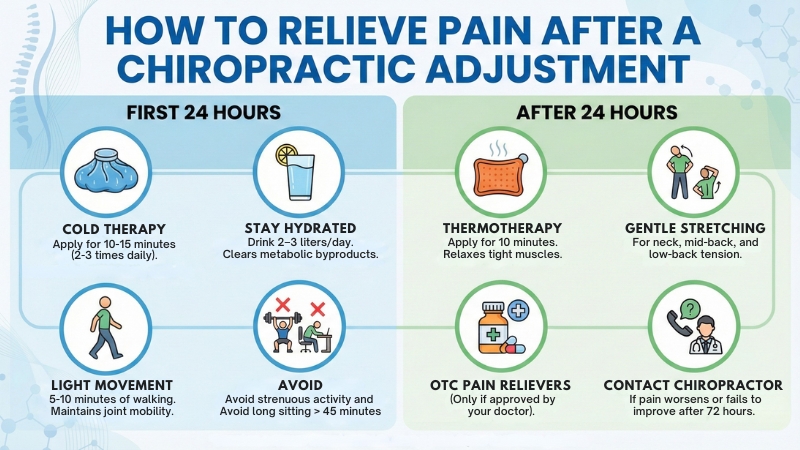
The way to relieve pain after a chiropractic adjustment is a targeted combination of ice, hydration, light movement, posture control, and supportive mobility work during the first 24–48 hours.
Quick Answer
These evidence-based methods offer direct and fast pain relief after chiropractic care:
First 24 Hours
- Apply ice for 10–15 minutes (2–3 times per day) to help reduce inflammatory cytokine activity.
- Hydrate well (Drink 2–3 liters of water every day) to clear metabolic byproducts.
- Use light movement such as 5–10 minutes of walking to maintain mobility.
- Avoid strenuous activity to prevent overstressing adjusting tissues.
- Avoid long sitting (>45 minutes) to reduce spinal load.
After 24 Hours
- Use heat for tight muscles (10 minutes).
- Gentle stretching for neck, mid-back, and low-back tension.
- OTC pain relievers (only if approved by your doctor).
- Contact your chiropractor if pain worsens or fails to improve after 72 hours.
Is It Normal to Feel Sore After a Chiropractic Adjustment?
Yes. Post-adjustment soreness is expected when the body is adapting to improved alignment and new joint loading patterns.
This mild discomfort reflects your body’s natural healing process as mobility and alignment improve.
Normal Soreness
- Localized, mild to moderate
- Improves daily
- Does not radiate
- Often accompanied by lighter posture or improved mobility
More common in
- First-time patients
- People with chronic stiffness
- Patients with posture distortion
Abnormal Symptoms
- Pain worsening on Day 2–3
- Sharp, shooting, or radiating pain
- Numbness, tingling, or weakness
- Pain persisting >72 hours without improvement
- Swelling, heat, or severe stiffness
Normal vs. Abnormal Pain After a Chiropractic Adjustment
Pattern | Description | Normal? |
Mild soreness 12–72h | Achy, improving each day | Yes |
Post-workout fatigue | Muscle tightness, stable | Yes |
Localized joint tension | Around treated area | Yes |
Pain worsening Day 2–3 | Escalating symptoms | No |
Radiating or sharp pain | Down arm/leg | No |
>72h no improvement | Persistent discomfort | No |
Why Does Soreness Happen After an Adjustment?
A chiropractic adjustment changes how spinal segments move, load, and stabilize, creating three predictable tissue responses:
1. Joint Capsule Stretching
Restored mobility stretches the joint capsule and alters capsular pressure, producing localized sensitivity.
2. Soft-Tissue Adaptation
Muscles and ligaments that previously supported misalignment must adjust to improved alignment, creating temporary tension similar to a light workout.
3. Neuromuscular Recalibration
Mechanoreceptors send updated positional information to the nervous system, prompting a reset of posture and movement control, sometimes causing mild fatigue.
As alignment improves, it’s normal to feel mild, short-term soreness while the body adjusts.
This early phase reflects healthy tissue adaptation as your spine shifts toward a more balanced load-bearing pattern.
Why CBP Patients May Feel More Soreness (2 -5 day)
Most patients feel mild soreness after a traditional chiropractic adjustment as joints regain motion and tissues adapt.
Patients in Chiropractic BioPhysics® corrective care, however, may feel slightly more soreness because CBP works at a deeper structural level.
Instead of only restoring motion, CBP changes:
- Structural loading patterns.
- Postural orientation.
- Sagittal and postural curve dynamics.
As these curves shift toward healthier alignment, the supporting tissues reorganize around a new load-bearing pattern.
This process can produce productive soreness lasting 2–5 days, showing that structural correction is actively occurring.
How Long Should Soreness Last After a Chiropractic Adjustment?
Most patients recover within 12–48 hours, though some may experience mild, improving soreness up to 72 hours, depending on posture habits, mobility baseline, and soft-tissue tension.
Day 1 (0–24 Hours)
- Dull, localized ache.
- Mild stiffness.
- Soreness may peak by the end of the day.
Day 2 (24–48 Hours)
- Noticeable improvement.
- Less tension.
- Mobility increases.
Day 3 (48–72 Hours)
- Minimal tightness.
- Posture feels lighter.
- No increase in symptoms.
Normal Duration by Patient Type
Patient Type | Typical Duration |
Average patient | 12–48 hours |
First-time patient | 48–72 hours |
Chronic stiffness | 48–72+ hours |
Posture distortion | 48–72+ hours |
CBP corrective-care patient | 2–5 days normal |
Detailed Breakdown of Relief Methods
Below is a streamlined, biomechanically accurate relief guide.
1. Apply Ice (First 24 Hours)
- What it does: Cools irritated joint capsules and tissues.
- Why it works: Reduces inflammatory cytokine activity around newly mobilized joints.
- When: 10–15 minutes, 2–3 times in the first 24 hours.
2. Hydrate to Support Circulation
- What it does: Improves tissue hydration and supports nervous system recovery.
- Why it works: Hydration helps clear metabolic byproducts released as tissues decompress.
- When: Consistently during the first 48 hours.
3. Use Gentle Movement to Maintain Mobility
- What it does: Prevents stiffness and sustains range of motion.
- Why it works: Low-impact movement maintains the mobility arc of corrected joints.
- When: Walking, stretching, gentle yoga in the first 48 hours.
4. Maintain Good Posture
- What it does: Reduces mechanical stress on corrected segments.
- Why it works: Slouching increases compressive load and slows tissue adaptation.
- When: All day, especially during prolonged sitting.
5. Use Heat After 24 Hours
- What it does: Relaxes tight muscles and improves blood flow.
- Why it works: Heat reduces muscle guarding that can follow alignment change.
- When: After the initial inflammation window.
6. Natural Anti-Inflammatory Support
What it does: Helps regulate low-grade inflammation, reduce soft-tissue tension, and support overall recovery after an adjustment.
Why it works: Natural compounds such as turmeric/curcumin, magnesium, and light soft-tissue massage help modulate muscle tone, improve circulation, and reduce inflammatory load without interfering with spinal alignment stabilization.
When to use it: During the 48–72-hour recovery window, especially if residual tightness or mild inflammation persists.
What Should You Not Do After a Chiropractic Adjustment?
For the first 24 hours, avoid anything that increases inflammation or overloads newly corrected joints:
Avoid | Why |
Heavy lifting (>20 lbs) | Increases joint compression |
Hard workouts | Overloads adapting tissues |
Twisting motions | Stresses joint capsules |
Long sitting (>45 min) | Raises spinal load |
Stomach sleeping | Increases torque on spine |
Alcohol | Slows tissue recovery |
Does Being Sore Mean the Chiropractic Adjustment Didn’t Work?
No. Soreness typically means your spinal joints regained mobility and your muscles are adapting to a healthier alignment.
Some patients feel immediate relief, while others feel mild soreness before improvements appear.
How Can You Reduce Pain for Future Adjustments?
These habits help the body adjust faster and reduce the likelihood of soreness after a chiropractic adjustment:
- Stay hydrated daily.
- Warm up before adjustments.
- Keep a consistent treatment schedule.
- Avoid slouching or forward head posture.
- Use low-impact movement daily.
- Do your corrective exercises.
- Avoid sitting for long periods.
- Strengthen core & postural muscles.
- Support structural corrections with CBP exercises.
These habits prevent your body from reverting to old patterns.
Frequently Asked Questions
Who is more likely to feel sore?
First-time patients, those with chronic stiffness, or those with poor posture or hydration.
Can I exercise after a chiropractic adjustment?
Light exercise is safe; high-intensity activity should wait 24–48 hours.
Is soreness normal at Day 3?
Yes—if symptoms continue improving and remain mild and localized.
When is soreness at Day 4–5 normal?
Only when it is mild, improving, and associated with first-time care, posture distortion, or CBP corrective care.
When is Day 3–5 soreness not normal?
If pain is worsening, sharp, radiating, neurological, or unchanged after 72 hours.
Contact Your Chiropractor In Charleston, SC
If you notice worsening neck pain or back pain after an adjustment, or if your discomfort persists beyond 72 hours, it’s important to schedule a follow-up evaluation. Early follow-up protects your long-term recovery and prevents regression.

Free Initial Consult
Call: 843-225-1236
Please allow us up to 24 hours for a response. Should this be an urgent matter, please call the office directly. Thank you.