Blogs
How Often Should You Go to the Chiropractor?
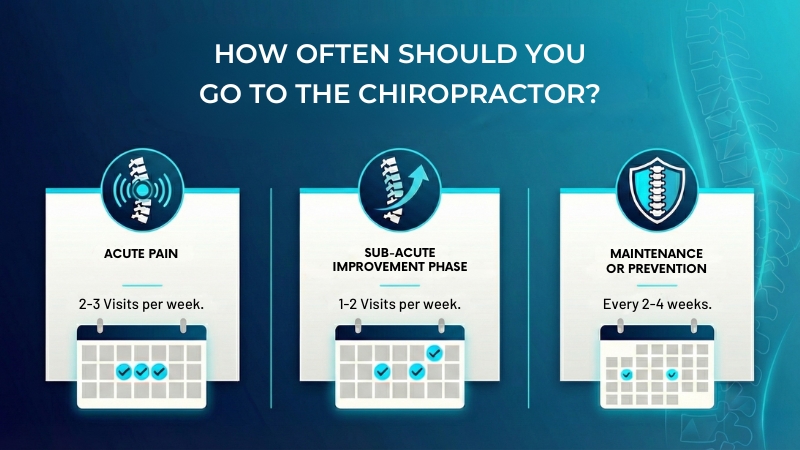
Most people should see a chiropractor 2–3 times per week during acute pain, 1–2 times per week during the sub-acute improvement phase, and every 2–4 weeks for maintenance or prevention.
These ranges reflect traditional chiropractic care, which bases visit frequency on symptom severity, tissue healing timelines, and nervous-system irritation patterns.
Quick Answer
- Acute pain: 2–3 visits per week.
- Sub-acute improvement phase: 1–2 visits per week.
- Maintenance or prevention: Every 2–4 weeks.
While traditional chiropractic bases visit frequency solely on symptoms, Axis Chiropractic uses CBP to determine yours based on structural misalignments.
This explains why corrective-care patients often require different timelines than those seeking simple relief.
What Determines How Often You Should See a Chiropractor?
A person’s visit frequency depends on what condition they have, how long the problem has been present, what structural deviations exist, and how their spine responds to care.
Condition Severity
Acute inflammation creates a “pathological loop” that reinforces itself quickly if visits are spaced too far apart.
The Cycle: Pain triggers muscle guarding → restricts circulation → traps inflammation → causes more pain.
To break this cycle, frequent adjustments in the first 2–4 weeks are essential. This stabilizes joint motion and clears inflammation before the spine has a chance to regress.
Pain Type and Location
Tissue healing rates vary significantly, directly influencing your visit frequency.
1. Nerve Irritation (6–12 Weeks):
Nerves have a limited blood supply and are highly reactive to inflammation. Because calming nerve root compression takes 6–12 weeks, closely spaced adjustments are required to keep pressure off the nerve and prevent “re-firing” between visits.
2. Soft-Tissue Injuries (6–8 Weeks):
Muscles and ligaments recover through movement. Without consistent mobilization during the critical 6–8 week window, tissues stiffen and adhesions develop. Frequent care ensures collagen fibers heal flexibly rather than rigidly.
3. Lower Back vs. Mid-Back:
The lumbar spine bears approx 60% to 68% of your body weight, making it highly susceptible to mechanical stress.
Consequently, lower-back conditions require more frequent stabilization than the mid-back, which is naturally supported by the rib cage.
Structural or Postural Issues
When posture breaks down—whether through forward head posture or pelvic rotation—joints overload and ligaments undergo long-term adaptation to the bad position.
Because stabilizing these structural shifts requires overcoming deep-seated ligament stiffness, consistent corrective care is essential.
This explains why two people with equal pain levels may have completely different schedules: one generally needs simple relief, while the other requires a rigorous plan to restore measurable structural alignment.
Recent Injury or Trauma
Whiplash trauma can cause ligament micro-tears and reduce cervical spine stability by approximately 20%. Without frequent reinforcement, the spine naturally drifts back toward its misaligned state.
We need a high frequency of care early on to counteract this instability and prevent your spine from “relapsing” between visits.
Lifestyle and Daily Demands
How Lifestyle Impacts Frequency If your routine fights your alignment, you need more support.
The Desk Worker: Sitting 8+ hours creates constant flexion stress, causing forward head posture to relapse in just 1–2 days. This requires a high-frequency start.
The Manual Laborer: Heavy lifting can re-irritate discs within 24–72 hours. Close-interval care is essential to prevent inflammation flare-ups.
The Active Patient: Consistent stretching helps the spine hold alignment for 5–7 days, permitting a less intensive schedule.
Personal Health History
Personal Health History Your medical history dictates both your healing speed and spinal stability.
1. Complex History (Surgeries, Scoliosis, Arthritis):
Factors like scar tissue and asymmetric loading cause the spine to destabilize quickly (often within 24–72 hours). This requires a higher visit frequency to prevent regression.
2. Chronic Pain Cycles:
Long-standing issues mean your tissues have adapted to dysfunction. We need a denser schedule early on to break this cycle before the body reverts to its old patterns.
Healthy History
Patients with good tissue quality hold alignment longer (5–7 days+), allowing for a less intensive schedule.
Treatment Plan Design
Effective chiropractic care follows a three-phase biological recovery model, not a random series of visits.
1. Relief Care: Targets acute pain and inflammation.
2. Corrective Care: Restores structural alignment and biomechanics (CBP® Focus).
3. Stabilization: Preserves long-term gains and prevents regression.
While traditional chiropractic often stops at Phase 1 (symptom relief), CBP guides you through the full cycle to achieve true structural correction.
Consequently, your visit frequency evolves naturally as you graduate from one phase to the next.
Clinical Examination
The examination acts as the blueprint for your care schedule. By assessing your spinal function, we determine if you require mild support or intensive correction.
Crucially, CBP uses digital X-ray analysis to remove subjectivity. We measure your biomechanical deviation to scientifically prescribe the exact visit frequency needed for correction.
Recommended Visit Frequency by Condition
Condition | Typical Visit Frequency | Timeline / Notes |
1. Acute Back & Neck Pain | 2–3 visits per week | Usually for 2–4 weeks until inflammation and muscle guarding decrease. |
2. Chronic Pain or Long-Term Conditions | 1–3 visits per week | 1–2 times for symptom management, up to 3 times for structural correction (CBP) |
3. Posture Problems & Tech Neck | 1–2 visits per week | Helps restore mobility and reduce forward-head strain. |
4. Sports Injuries | 2–3 visits per week initially | Frequency decreases as swelling, stiffness, and pain improve. |
5. Car Accident / Whiplash Recovery | 2–3 visits per week | Typically for 6–12 weeks, depending on ligament healing. |
6. Arthritis & Degenerative Disc Conditions | 1–2 visits per week | Helps control inflammation and maintain mobility. |
7. Sciatica & Disc Irritation | 2–3 visits per week initially | Supports nerve decompression and reduces flare-ups. |
8. Desk Workers & Sedentary Lifestyles | 2 visits per week initially, then 1 visit weekly | Higher frequency needed initially to counteract daily relapse (1–2 days) from sitting. |
How To Know If You’re Going Too Often (Or Not Enough)
1. Signs You May Need More Frequent Visits
- Pain returns quickly after each adjustment.
- Morning stiffness persists.
- Numbness, tingling, or headaches continue.
- Your posture collapses by mid-day.
2. Signs You May Be Going Too Often
- Soreness lasting more than 48–72 hours after routine visits.
- New joint irritation or headaches.
- No measurable improvement after several weeks.
3. When Your Visit Schedule Should Be Adjusted
Your chiropractor should modify your plan when your tissues show predictable recovery patterns, when pain stabilizes, or when new diagnostic findings emerge.
Sample Chiropractic Visit Schedule (Acute → Maintenance)
Your chiropractor at Axis Chiropractic examines your spine, reviews digital X-rays, and customizes your visit frequency based on structural findings, not guesswork.
Below is the Axis Chiropractic corrective-care model, integrating the traditional relief phase with the CBP structural-correction system.
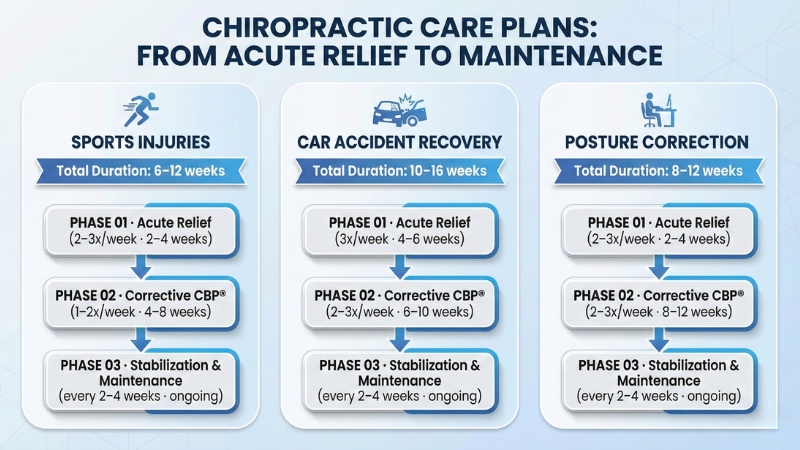
Phase 1: Relief Care (Traditional Approach)
Frequency: 2–3 visits per week for 2–4 weeks.
Goal: Reduce pain, calm inflammation, restore basic motion.
This phase focuses on traditional adjustments designed to decrease discomfort, relax spasms, and improve short-term mobility.
Phase 2: Structural Correction (CBP Approach)
This is where Axis Chiropractic differs from typical clinics.
Frequency: 1–3 visits per week, depending on X-ray measurements.
Techniques: Mirror-Image® adjustments, traction, neuromechanical remodeling.
Goal: Correct structural alignment and restore optimal spinal curves.
CBP visits are based on spinal modeling research, which shows that ligament deformation and postural change require consistent loading cycles over time.
Phase 3: Wellness & Long-Term Structural Maintenance
After structural correction is achieved, the focus shifts from fixing alignment to keeping alignment stable over time.
Frequency: every 2–4 weeks, depending on structural stability.
Goal: Preserve gains, prevent regression, and support long-term structural health.
Frequently Asked Questions
How Often Should You Get Your Back Adjusted?
Acute back pain requires 2–3 visits per week to reduce inflammation. Symptom management typically necessitates 1–2 visits per week, while structural correction (CBP) may require frequencies of up to 3 times per week.
How Often Should You Have Your Neck Adjusted?
Neck adjustments follow the same clinical timeline as back pain. Acute flare-ups require 2–3 weekly visits, reducing to 1–2 weekly visits once symptoms stabilize and mobility improves.
How Many Times Should You Go to the Chiropractor?
Standard chiropractic care plans range from 6 to 24 visits. However, patients with complex trauma or those undergoing structural correction often require 30+ sessions to achieve permanent change.
Is It Safe To Go to the Chiropractor Every Week?
Yes, weekly chiropractic adjustments are safe for most adults. This frequency specifically benefits individuals with sedentary lifestyles, repetitive job stress, or chronic stiffness.
How Long Should You Wait Between Chiropractic Adjustments?
Active care patients benefit from an interval of 2 to 7 days between visits. This spacing prevents regression while allowing tissues sufficient time to adapt to changes.
How Often Should You Go for Maintenance Care?
Maintenance care occurs every 2–4 weeks. The primary goal of this phase is to preserve long-term mobility, prevent pain recurrence, and maintain optimal function.
How Long Should You Continue Chiropractic Care?
Treatment continues until the patient demonstrates measurable clinical improvement. Key indicators for discharge or phase progression include reduced pain levels, increased mobility, and corrected posture.

Free Initial Consult
Call: 843-225-1236
Please allow us up to 24 hours for a response. Should this be an urgent matter, please call the office directly. Thank you.